
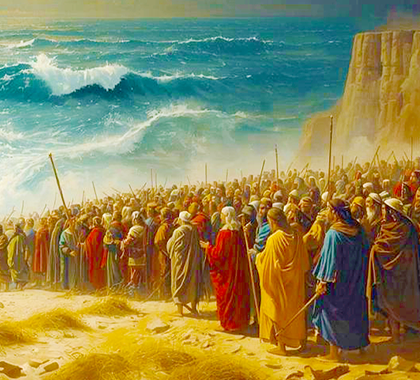
In Parshat Beshalach, the Maor VaShemesh teaches that the longer road out of Egypt was not a tactical detour but a spiritual necessity. Had Israel gone straight into Eretz Yisrael, the goal of the journey, the work of refinement would have been incomplete. Mixed in with Bnei Yisrael was the erev rav, those drawn by miracles and fear rather than by true teshuvah. Bringing them immediately into the Land would have planted confusion and spiritual damage at the very heart of holiness.
The desert, Kriat Yam Suf, and the encounter with war were stages of birur. Pressure reveals truth. When the Torah says “פן ינחם העם”, “lest the people reconsider,” ha’am refers to the erev rav, those who retreat when faced with fear and struggle. By contrast, “וחמושים עלו בני ישראל” means that Israel ascended spiritually armed, attached to the fiftieth gate, the world of teshuvah, and fortified through daily kabbalat ol malchut shamayim.
Kriat Yam Suf itself is described as a moment of radical revelation, when Hashem illuminated even the achorayim, the places normally dominated by darkness and resistance. This redemption could not come through prayer alone, but through a higher unveiling of divine inner will that shattered the hold of impurity at its root.
The Maor VaShemesh leaves us with a demanding message. Not every act of closeness builds holiness. Without inner change, enthusiasm can become distortion. True geulah requires patience, discernment, and inner readiness, so that holiness is built on truth, not on appearances.
Use this source sheet, complete with footnoted sources and a concise, footnoted bio of R. Kalonymus Kalman Epstein (Ma’or Va-Shemesh) to enjoy this teaching at your own pace, perfect for self-learners.
Prepared by Rabbi Shalom (Saul) Orbach
The Ma’or Va-Shemesh is a classic Hasidic commentary on the weekly portions and festivals by R. Kalonymus Kalman Epstein of Kraków (1751-1823). A foremost later disciple, and for years the Shamash, of R. Elimelech of Lizhensk, he emerged after his rebbe’s passing as a leading figure in the fourth generation of Chassidut and of Polish Hasidism. His Torah blends close reading of the Psukim with mystical depth, emphasizing Dvekut, heartfelt prayer, joy, and sanctifying the everyday, with a hallmark leadership ethic: the tzaddik sweetens judgment into mercy and draws people close.