
In this week’s parsha, the Ma’or Va-Shemesh develops a profound vision of spiritual growth, the inner nature of the Mishkan, and the deep spiritual connection between the leaders of Israel and the souls of the people.
He begins with a question on the word “לאמר” (“saying”). Usually, “לאמר” means that when Hashem tells someone something, it is meant to be passed onward to others, in this case from Hashem to Moshe and then to the Jewish people. But here, no further message follows. What, then, is the meaning of “לאמר” in this context?
The Ma’or Va-Shemesh explains, based on Chazal, that “אמירה” (amirah, gentle or inward speech) implies something quieter and more hidden, while “דיבור” (dibur, open proclamation) represents public and outward expression. This reflects different stages in avodat Hashem (service of God). At the beginning of spiritual growth, a person often needs intense effort and outwardly visible spiritual excitement in Torah and tefillah (prayer) in order to break free from a state of spiritual constriction and limitation. This is the stage of initial awakening, when the avodah (spiritual work) is energetic, emotional, and externally expressed.
But after spiritual maturation, and especially after a person experiences later descents and struggles and learns how to rebuild from them, one can reach a deeper level where the avodah becomes quieter, more פנימי (penimi, inward and internal), and more hidden, yet filled with even greater אהבה ויראה (ahavah v’yirah, love and awe of God). The external intensity becomes internalized. The highest spiritual maturity is not the intensity of the first awakening, but the quieter depth that emerges after struggle, return, and rebuilding.
This, he explains, is the movement from Har Sinai to the Mishkan. Sinai was a moment of overwhelming public revelation, with thunder, sound, and open display. The Mishkan represents a different kind of relationship with Hashem, one that is quieter, more intimate, and carried within the life of the people themselves. Holiness is no longer only encountered in dramatic moments of revelation, but internalized and sustained from within.
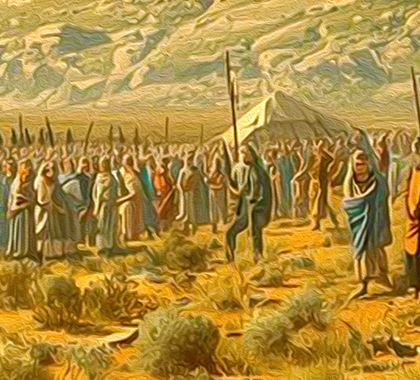
He then explains that the census in Bamidbar was not merely intended to count the Jewish people numerically. The very act of counting was itself part of a תיקון (tikkun, spiritual repair and elevation) for כלל ישראל (Klal Yisrael, the collective people of Israel) and for the souls connected to them. This is reflected in the Torah’s unusual phrase שאו את ראש (“lift up the heads”) rather than simply “count them.” The counting itself was meant to spiritually elevate the people and draw them upward.
The census also helped elevate and repair souls from earlier generations, including souls that had returned through גלגול (gilgul, the return of a soul in a later life in order to continue or complete its spiritual mission in this world). Even the wording of the פסוקים (pesukim, verses) reflects how later generations can spiritually elevate earlier ones, while the קדושה (kedushah, holiness) and merit of the אבות (Avot, the forefathers) continue to protect and shape their descendants.
Finally, he presents a profound understanding of Jewish leadership. Moshe, Aharon, and the נשיאים (Nesi’im, tribal leaders) were not simply leaders in an organizational sense. They were נשמות כוללות (neshamot kolelot, collective souls of Israel). Through deep attachment to the people and a kind of spiritual selflessness, they were able to elevate them spiritually and draw down רחמים and קדושה (rachamim and kedushah, Divine compassion and holiness) upon them.
The Ma’or Va-Shemesh connects this to the kabbalistic idea of עיבור (ibur, a spiritual “inter-inclusion” in which one soul carries and nurtures another within itself), where the leader spiritually “carries” and nurtures the souls of his people within himself.
What emerges from all three pieces is a unified vision of spiritual growth as a movement from the external to the internal. In the beginning, holiness often appears through intensity, visible effort, and public expression. But as a person matures spiritually, the avodah becomes quieter, deeper, and more inwardly rooted.
Sinai shakes the world. The Mishkan rests quietly within it. The census counts bodies, but beneath the surface it is also lifting, repairing, and reconnecting souls to their source. And the leader who counts is not merely an administrator, but a נשמה כוללת (neshamah kolelet, a collective soul), spiritually carrying the people within himself.
In the end, the goal isn’t just to experience holiness in a moment of inspiration, but to become a person in whom holiness can quietly dwell.
Use this source sheet, complete with footnoted sources and a concise, footnoted bio of R. Kalonymus Kalman Epstein (Ma’or Va-Shemesh) to enjoy this teaching at your own pace, perfect for self-learners.
Prepared by Rabbi Shalom (Saul) Orbach
The Ma’or Va-Shemesh is a classic Hasidic commentary on the weekly portions and festivals by R. Kalonymus Kalman Epstein of Kraków (1751-1823). A foremost later disciple, and for years the Shamash, of R. Elimelech of Lizhensk, he emerged after his rebbe’s passing as a leading figure in the fourth generation of Chassidut and of Polish Hasidism. His Torah blends close reading of the Psukim with mystical depth, emphasizing Dvekut, heartfelt prayer, joy, and sanctifying the everyday, with a hallmark leadership ethic: the tzaddik sweetens judgment into mercy and draws people close.