
The Maor VaShemesh asks why the declaration accompanying Bikkurim tells the story of “Arami oved avi,” our descent to Egypt, the suffering there and the Exodus. What does any of this have to do with bringing the first fruits?
His first answer connects Bikkurim to Chet Adam HaRishon. At the root of Adam’s sin was the inability to restrain desire and wait for the proper time. Bikkurim is a tikkun: precisely when the first fruit appears and the farmer most desires it, he must restrain himself and dedicate it to Hashem.
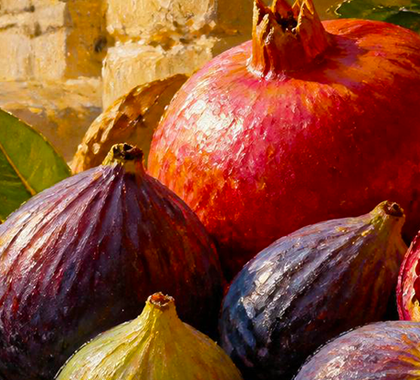
This explains Rashi’s specific example of a fig that ripens first. According to one opinion in Chazal, the Eitz HaDa’at was a fig tree: “bedavar shekilkelu, bo nitaknu” — that which was used for the sin becomes the means of its repair. Even the beautiful fruit used to decorate the Bikkurim strengthens the test: the greater the desire, the greater the kefiyat hayetzer.
The Maor VaShemesh then offers a second explanation. “Arami oved avi” refers to Lavan’s attempt to overwhelm Yaakov with worldly concerns until he would come to resent them as obstacles to his avodat Hashem. Now, as Bnei Yisrael enter Eretz Yisrael and receive fields, vineyards and material blessing, they face the same danger: seeing Hashem’s gifts as distractions from serving Him.
Bikkurim teaches the opposite. We take the very produce that occupies our time and bring its first fruits to Hashem. The declaration is, as Rashi says, an expression “she’eincha kafui tovah” — recognizing that the material blessings of Eretz Yisrael are themselves gifts from Hashem, and can themselves become part of our avodah.
Use this source sheet for further exploration of Parshat Ki Tavo, complete with footnoted sources and a concise, footnoted bio of R. Kalonymus Kalman Epstein (Ma’or Va-Shemesh) to enjoy this teaching at your own pace, perfect for self-learners.
Prepared by Rabbi Shalom (Saul) Orbach
The Ma’or Va-Shemesh is a classic Hasidic commentary on the weekly portions and festivals by R. Kalonymus Kalman Epstein of Kraków (1751-1823). A foremost later disciple, and for years the Shamash, of R. Elimelech of Lizhensk, he emerged after his rebbe’s passing as a leading figure in the fourth generation of Chassidut and of Polish Hasidism. His Torah blends close reading of the Psukim with mystical depth, emphasizing Dvekut, heartfelt prayer, joy, and sanctifying the everyday, with a hallmark leadership ethic: the tzaddik sweetens judgment into mercy and draws people close.